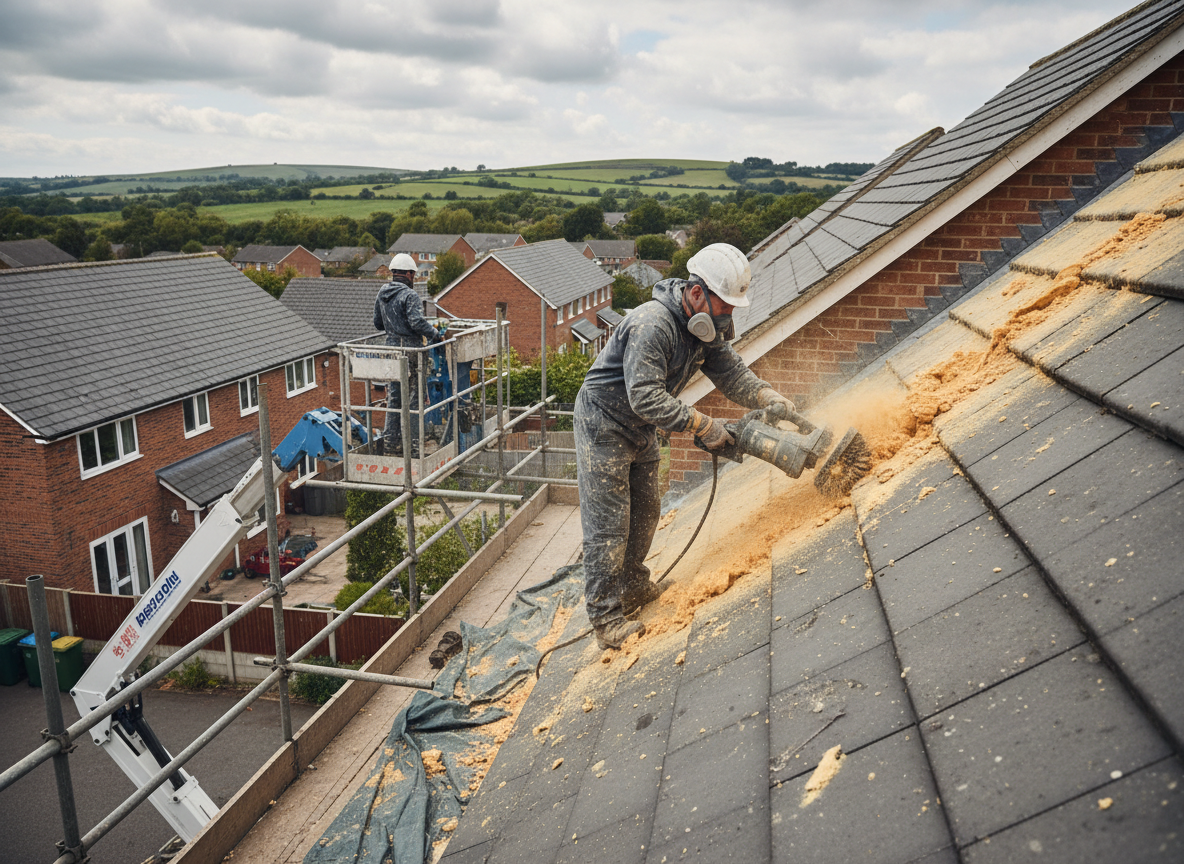
Telford properties built during the 1960s and 1970s new town expansion often received closed-cell spray foam on pitched and flat roofs around estates such as Halesfield, Dawley and Madeley. Over time this foam traps moisture against rafters because original eaves and ridge ventilation was minimal, leading to timber decay that only becomes visible once the foam is stripped. Removal crews must work in sections to avoid sudden load shifts on older trusses while containing dust that can migrate into loft insulation still present in neighbouring homes.
Shropshire's frequent rain and high humidity mean any exposed roof deck must be dried and checked for rot before new insulation is considered. Crews use negative-air machines at ridge level to pull particles away from living spaces below, especially important in semi-detached houses where party walls allow dust to travel. Edge cases include foam applied over older felt on flat roofs above garages, where the foam has bonded directly to the deck and requires careful mechanical scraping rather than heat methods that could ignite residue.
Local building control expectations in the Telford area require that any exposed roof void after removal meets current ventilation standards before re-covering. This often means fitting additional soffit vents or ridge tiles that were never part of the original 1970s construction. Homeowners frequently discover that removing the foam reveals missing or damaged felt under the tiles, turning a simple extraction into a partial re-roofing job that must be coordinated with local roofing contractors familiar with Shropshire slate and concrete tile profiles.
Technician insight
In Telford, the thing that catches most people out with roof spray foam removal is how 1970s Halesfield houses often have foam filling the eaves completely, blocking any original airflow and bonding so tightly to the rafters that pulling it tears the timber surface and creates new rot points that only show up after a wet Shropshire winter.
Foam Stripped from Dawley Bungalow Loft
Homeowner noticed musty smell after heavy autumn rain. Inspection found closed-cell foam covering every rafter in the 1972 bungalow roof with no ridge vent. Crew cut the foam into manageable strips, used negative air to protect the kitchen below, scraped residue and opened two new soffit vents before leaving. Moisture readings dropped to acceptable levels within a week.
How it works
- 1
Site Assessment
Inspect roof void, measure foam depth, check rafter condition and ventilation paths in Telford properties.
- 2
Containment Setup
Install dust barriers, negative air units and ground protection around the access point at the Halesfield address.
- 3
Foam Extraction
Cut and peel foam in controlled sections, scraping residue from timber without gouging original rafters.
- 4
Debris Removal and Clean
Bag all waste, vacuum residual particles and verify ventilation openings before leaving site.
Pricing
Upfront quotes based on roof size, foam thickness and access difficulty; no fixed rates published.